
If you also think of yourself as useless, then you must read this…
The world of honeybees is one of nature’s most astonishing miracles, where every individual is busy performing a specific role. Inside this tiny hive operates a complex social system whose two most important figures are the queen and the drones. Their lives are so different that it is hard to believe they belong to the same species.
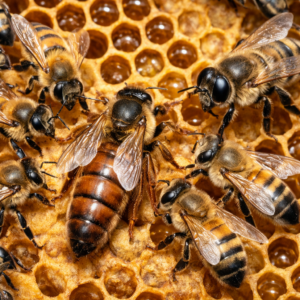
The queen bee is the heart of the colony, a monarch who lives among her subjects yet is so unique that she stands apart in every way. Her body is noticeably longer and more elegant than other bees, and when she moves inside the hive, worker bees surround her like guards protecting their queen. Interestingly, however, the queen is not born a princess. She comes from an ordinary egg, just like any worker bee.
The only difference is that when the colony needs a new queen, worker bees begin feeding certain larvae a special substance called “royal jelly.” This milky white food is so powerful that it changes the entire genetic destiny of the larva. A larva that might have become an ordinary worker instead becomes a queen. It is a masterpiece of nature’s chemistry: simply by changing the diet, a bee’s entire life, size, lifespan, and abilities are transformed.
One of the most fascinating chapters of the queen’s life is her mating flight, which happens in daylight rather than at night. When the queen matures, she leaves the hive only once in her lifetime for this purpose. She flies high into the sky, and drones chase after her. It becomes an extraordinary competition, with hundreds of male bees pursuing one queen, though only a few reach her. The queen mates with several drones in the air and stores their sperm inside her body, enabling her to lay millions of eggs over the next five years.
Now consider the story of the drones, perhaps among nature’s strangest creations. These male bees are born without a father. When the queen lays unfertilized eggs, they develop into drones containing only the mother’s genes. These bees are larger, have big eyes, and live carefree lives. They have no sting, do not make honey, do not collect pollen, and do not even gather their own food. Worker bees feed them, almost as if idle princes are being raised.
A drone’s entire life has only one purpose: to mate with a queen. But here lies the irony—any drone that succeeds dies immediately after mating because his reproductive organs remain inside the queen. Success itself leads to death. And the drones that fail in this competition do not fare much better.
When winter approaches and food becomes scarce, worker bees throw the lazy drones out of the hive. It is a harsh decision but necessary for the colony’s survival. The drones die from cold and hunger, while the workers and the queen survive the winter safely inside the hive.
This system is strange yet remarkably successful. A queen, who can live up to five years, lays more eggs daily than her own body weight. Imagine laying around two thousand eggs per day—one every few seconds—continuing for months. She releases special chemical signals that keep the entire colony united. If the queen dies or becomes weak, the colony realizes it within hours and immediately begins raising a new queen.
Though the drone’s story may seem tragic, their existence is just as essential as the queen’s. They bring genetic diversity to the colony. By mating with multiple drones, the queen ensures the next generation carries a mix of traits, improving resistance to diseases and increasing survival chances in different conditions.
Honeybees possess an astonishing ability that scientists call the “waggle dance.” When a worker bee finds a good source of flowers or food, she doesn’t simply bring honey back. Instead, she returns to the hive and performs a special dance.
Through this dance, she tells the other bees the direction of the food source, how far away it is, and how abundant it is. The angle of the dance indicates the direction relative to the sun, while the duration of the dance communicates the distance.
The most fascinating part is that bees also account for the movement of the sun. Even if the sun has shifted position, the bee still communicates the correct direction in her dance, as if she possesses both a natural compass and an internal clock.
In other words, this tiny insect uses a system involving mathematics, navigation, time calculation, and collective communication—one that has functioned for millions of years without any teacher or school.
Thus, within a tiny hive exists a complete kingdom: a queen who rules, thousands of hardworking workers serving the colony’s welfare, and drones who play a temporary but essential role in producing the next generation. This system has functioned for millions of years without law books, police, or armies—perhaps far more organized and successful than human societies.